Thursday Oct 15, 2026
Thursday Oct 15, 2026
Thursday, 26 February 2026 01:57 - - {{hitsCtrl.values.hits}}
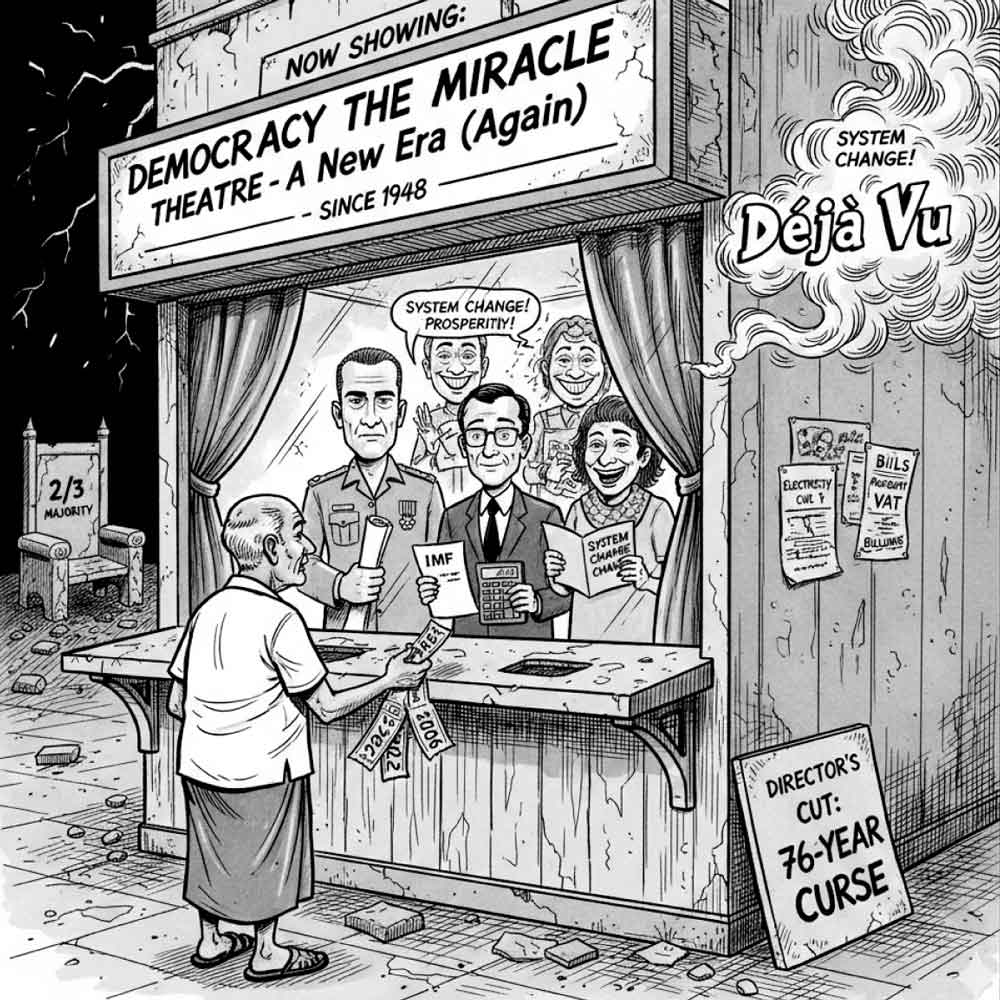
 We are standing in the debris of yet another “new era” that promised to save us. If you are feeling a sense of déjà vu, you are not alone. In fact, you should be feeling it. We are living through a rerun of a bad movie we watched just six years ago, only this time the actors have changed costumes.
Looking back at the chaotic trajectory of the last decade, from the technocratic dreams promised by Gotabaya Rajapaksa in 2019 to the radical “System Change” heralded by Anura Kumara Dissanayake and the National People’s Power (NPP) in 2024, a disturbing pattern emerges. It is a pattern that cannot be explained solely by economic desperation or political immaturity. It is rooted in a fundamental glitch in the human mind known as the “Illusory Truth Effect.”
As the euphoria of the “Purple Wave” fades and the cold reality of governance settles in, we must ask ourselves a difficult question. Are we witnessing a failure of governance, or a failure of our own ability to distinguish comfortable lies from uncomfortable truths?
The architecture of belief
To understand why we are here, again, we have to look at how our brains work. In 1977, researchers at Villanova and Temple Universities identified a cognitive bias that explains much of Sri Lankan political history: the Illusory Truth Effect. The premise is terrifyingly simple. If you repeat a false statement often enough, people will eventually believe it is true.
This happens because our brains are “cognitive misers.” We prefer things that are easy to process. When we hear a statement repeated over and over, whether it is “organic fertiliser will save us” or “we will recover billions in stolen assets,” it becomes familiar. That familiarity creates a feeling of “cognitive fluency,” which our brain lazily interprets as truth. We do not believe these things because we have fact-checked them. We believe them because they feel true.
 To break the “76-year curse,” we don’t just need a system change in parliament. We need a cognitive system change in the electorate. We need to develop “epistemic vigilance”. We need to learn that if a political promise sounds too good to be true and is repeated until it feels like a song stuck in your head, it is probably a lie
In Sri Lanka, this vulnerability has been weaponised. We tend to elect leaders with overwhelming majorities based on simple, repetitive slogans, only to watch in horror as those slogans crash against the rocks of reality.
The ghost of 2019: The technocratic illusion
Let us rewind to 2019. The country was reeling from the Easter Sunday attacks. We were scared, and we wanted a saviour. Enter Gotabaya Rajapaksa and his “Vistas of Prosperity.”
The narrative was seductive in its simplicity. We were told that our economic woes were not due to structural debt or a lack of revenue, but simply due to a lack of “discipline” and “patriotism.” The solution offered was just as simple: huge tax cuts would stimulate the economy, and a ban on chemical fertiliser would save our foreign exchange reserves.
These claims were repeated by “experts,” by the media, and by the candidate himself until they became gospel. We didn’t pause to ask how cutting taxes would help a country that was already broke. The repetition drowned out the skepticism. We handed the SLPP a near two-thirds majority in 2020, believing we were voting for competence.
We all know how that movie ended. The “technocratic” Government drove the country into a sovereign default, and the very people who cheered for the “strong leader” eventually stormed his palace in 2022. The illusion shattered, but the psychological mechanism that created it remained intact.
The purple haze of 2024
Fast forward to the aftermath of the Aragalaya. We were angry. We wanted justice. And just like in 2019, a new force emerged with a simple, repetitive narrative that perfectly matched our emotional state.
The NPP’s campaign was a master class in the Illusory Truth Effect. Their slogan was the “76-year curse.” They lumped every past leader into a single bucket of “corrupt elites” and offered a binary choice: “Them (The Thieves)” versus “Us (The Clean)”.
The promises were intoxicating. They told us they would renegotiate the “destructive” IMF deal. They told us that billions of dollars were stashed offshore and that bringing this “stolen money” back would solve our Budget deficit without painful taxes. They promised to slash electricity and fuel bills by 30% simply by eliminating corruption.
We wanted to believe it. It felt good to believe it. So, in November 2024, we suspended our disbelief and gave the NPP a historic supermajority of 159 seats. We replaced the “War Hero” with the “Incorruptible Son of the Soil,” hoping that this time, the magic would work.
The morning after: 2026
Now, in February 2026, the honeymoon is over. The “System Change” we were promised looks a lot like “Structural Compliance.”
The most glaring U-turn has been on the economy. During the campaign, the IMF deal was portrayed as a choice made by traitors. Once in power, however, the NPP administration quietly realised what economists call TANA (“There Are No Alternatives”). They have largely continued the macroeconomic policies of the Wickremesinghe administration, including the strict debt sustainability targets. The “renegotiation” was mostly semantic. The austerity remains.
As we navigate 2026, the tragedy is not that the NPP lied to people. It is that people begged them to lie, because the truth was too hard to bear. Until we grow up as an electorate, we will keep buying tickets to the same movie, hoping for a different ending
What about the “stolen billions”? We have seen plenty of theatrical arrests and cameras flashing as former VIPs are hauled into court. This “performative accountability” satisfies our thirst for vengeance, but it hasn’t filled the treasury. The stolen assets have not materialised to plug the Budget deficit, forcing the Government to keep the high VAT rates and income taxes they once decried. The illusion of easy money has faded, leaving us with the hard reality of tax collection.
Then there is the cost of living. Voters who expected a 30% drop in electricity bills are still waiting. The Government has had to face the reality that global oil prices and a depreciating rupee dictate tariffs, not political rhetoric. The CEB and CPC are still asking for price hikes because, structurally, the state cannot afford to subsidise us anymore. The promise was simple; the reality is expensive.
Perhaps most concerning is the “inexperience factor.” The 10th Parliament is filled with over 150 first-time MPs. While “fresh faces” sounded great on a campaign poster, the practical result has been a Government that is struggling to operate the complex machinery of the state. Critics argue that the administration is on a steep learning curve, often reacting defensively to valid criticism rather than correcting course.
The curse of the supermajority
There is a deeper lesson here about power. Sri Lankan voters have a dangerous habit of granting two-thirds majorities to leaders who promise to fix everything. We did it for J.R. Jayawardene in 1977, for the Rajapaksas in 2010 and 2020, and now for the NPP in 2024.
History tells us that supermajorities are not a blessing; they are a curse. They remove the safety rails. When a Government has no effective opposition, it begins to believe its own propaganda. It creates an echo chamber where bad ideas, such as the 2021 fertiliser ban or the current delays in constitutional reform, go unchallenged until it is too late.
Despite promising to abolish the Executive Presidency, the NPP Government seems in no rush to dismantle the throne it now occupies. The 2026 Budget allocated no funds for a constitutional assembly. Power, once acquired, is rarely relinquished voluntarily. We are seeing the same hubris that brought down previous regimes, fueled by a mandate that was too large for anyone to handle responsibly.
Breaking the cycle
So, where do we go from here? Are we doomed to repeat this cycle forever?
The Aragalaya changed the faces in power, but it didn’t change the psychology of the voter. We swapped one messiah for another. We rejected the complexity of our problems in favour of the comfort of simple slogans.
To break the “76-year curse,” we don’t just need a system change in parliament. We need a cognitive system change in the electorate. We need to develop “epistemic vigilance”. We need to learn that if a political promise sounds too good to be true and is repeated until it feels like a song stuck in your head, it is probably a lie.
We need to stop rewarding politicians who tell us that the solution is easy: that it’s just about catching thieves or planting trees. We need to start listening to the ones who tell us the truth, even when it hurts. The truth is that no “stolen money” pot of gold will pay our debts. The truth is that energy is expensive. The truth is that recovery will take a decade of hard work, not one election cycle.
As we navigate 2026, the tragedy is not that the NPP lied to people. It is that people begged them to lie, because the truth was too hard to bear. Until we grow up as an electorate, we will keep buying tickets to the same movie, hoping for a different ending.
One must ask: is the current daily volatility in governance lowering the system’s benchmark to such an extent that it will become impossible to restore the decade-long standards of the Sri Lankan civil service—an institution we inherited from the colonial era, which, despite its flaws, provided a foundation of stability? ”
(The writer is an Environmentalist/Wildlife Conservationist/Citizen Scientist. He can be reached via email: [email protected].)




